
Reviewed · HIKING & TREKKING
Petra Back-Road Trail and Hike
Petra’s grandest surprise is not the Treasury. It is the walk into Petra from Little Petra, where the route moves through quiet mountain country, an old settlement, and the narrow Siq Ghorab before reaching the Monastery. The Treasury then arrives later, as a fitting finale rather than your first stop.
I like the small maximum of six and the route’s variety: you get Little Petra, a proper hike, the Monastery, and the central ruins in one long day. I also like the views toward Wadi Araba and the west bank mountains, which give you a wider sense of Petra than the usual front-door visit. The catch is simple: this is a demanding day with more than 800 steps to the Monastery, uneven ground, and roughly eight to nine hours on the move.
Key points to know before booking
- Little Petra is your starting point: You begin at Siq al-Barid, then continue toward Petra by a less usual mountain route.
- The Monastery comes before the Treasury: This changes the rhythm of a standard Petra visit and makes the Treasury a later highlight.
- The hike requires solid fitness: The route includes steep paths, uneven terrain, and more than 800 steps near the Monastery.
- The group is limited to six: A small party should make guiding and pacing easier than a large coach excursion.
- Several major monuments are covered: You see the Monastery, Colonnaded Street, Street of Facades, Royal Tombs, Treasury, Nymphaeum, and Byzantine Church.
- The $380 price is per group: If six people join, the cost works out to about $63 per person, but a solo booking carries the full group price.
Why the back route changes your Petra day
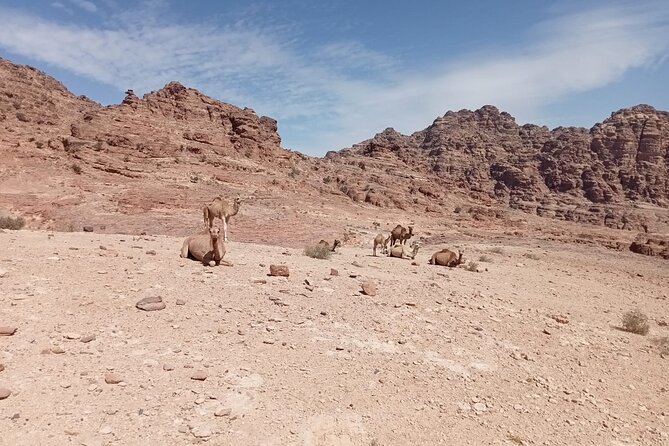
Most people first meet Petra through the famous entrance and the Siq leading to the Treasury. This tour reverses the order. You start at Little Petra, also called Siq al-Barid, and approach the main archaeological area on foot through mountain scenery.
That matters because Petra is not only a collection of carved facades. The setting is part of the experience. The back route gives you open views, rock walls, old paths, and a sense of how much ground the Nabataean city occupied. You also reach the Monastery before walking through the central ruins toward the Treasury.
This is not a quick sightseeing circuit. The advertised duration is eight to nine hours, with a 9:00 am start. You need to be comfortable spending most of the day outside and walking over uneven ground. The group limit of six is a real advantage here. A guide can keep the pace more personal, and you have a better chance to ask questions without competing with a busload of people.
The guide can either pick you up or meet you at Little Petra. The exact pickup arrangement should be settled before the day begins. Public transportation is nearby, and service animals are allowed, but the main practical point is the walking. Good shoes, water, sun protection, and a willingness to climb matter more than transport convenience.
More Hiking Tours in Petra:
- Dana to Petra Trek + Wadi Rum & the Dead Sea – 9 Days
★ 5.0 · 165 reviews - Petra to Wadi Rum Trek – 6 Days
★ 5.0 · 11 reviews - Jordan Trail: Dana to Petra 4-Day Trekking Tour
★ 4.4 · 7 reviews
Little Petra and Beidha set the scene
Your first stop is Al-Beidha, better known to many visitors as Little Petra. The name Siq al-Barid means cold canyon, a reference to the shade and enclosed rock walls along parts of the passage.
Little Petra is much smaller than the main Siq, but it has its own character. The narrow canyon opens into wider pockets with rock-cut temples and old structures. You can see ancient painted houses and carved spaces along the walls. These details make the stop more than a short photo pause.
The visit also includes the Neolithic Village of Beidha, described as one of Jordan’s oldest settlements. Seasonal hunter-gatherers lived here during the Neolithic period. That gives your day a much earlier starting point than Petra’s Nabataean monuments.
Allow about two and a half hours for this opening section. That is a substantial amount of time, and it helps you appreciate the smaller site before the hike begins. The possible drawback is that the full day can feel long if you prefer to focus only on Petra’s famous facades. If you enjoy archaeology and older settlement sites, this extra stop adds useful context.
The hike through Siq Ghorab
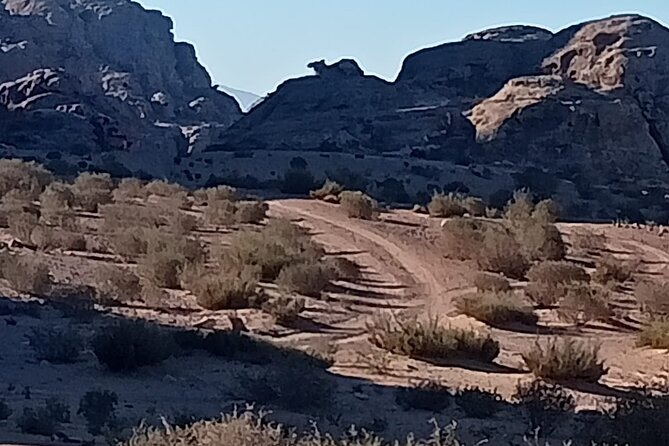
From Little Petra, you continue toward the main Petra site by foot. The route passes through striking mountain scenery and eventually reaches the old village area, where remains point to people who lived here thousands of years ago.
A key point on this approach is Shamasah, reached through the large canyon known as Siq Ghorab. The route gives you a different kind of Petra experience: less emphasis on grand monuments at first, more attention to rock formations, open views, and the path itself.
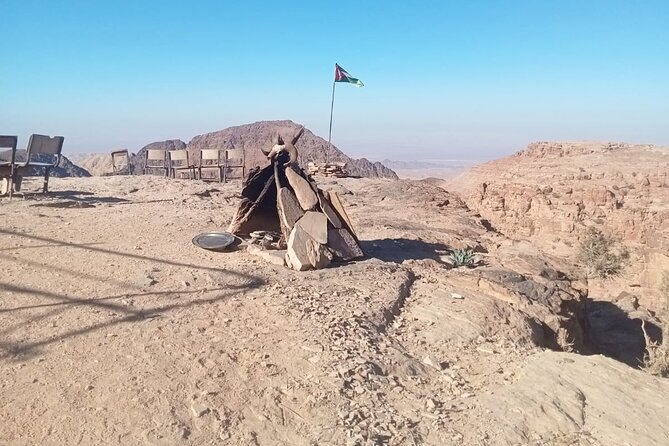
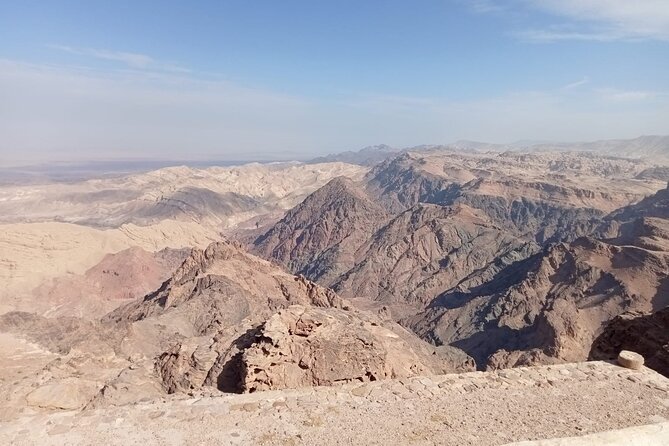
The guide leads you toward a panoramic point overlooking Wadi Araba and the mountains to the west. This is one of the strongest reasons to choose the back route. The view lets you understand Petra as a place connected to a much wider region, not simply a site hidden inside a canyon.
The wording of the tour description calls these scenes marvelous and magnificent, but the practical message is clearer: you should expect a real hike. The surface can be uneven, and the route includes climbs. The tour requires moderate physical fitness, which is a fair warning. It is not presented as a gentle walk between vehicle stops.
Reaching the Monastery after 800 steps
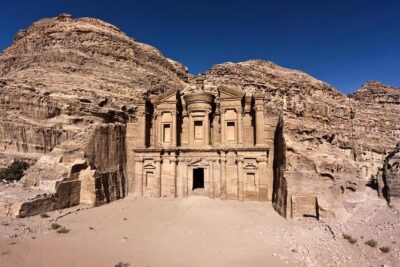
The Monastery, or Al-Dayr, is the major reward of the uphill section. It is one of Petra’s largest monuments, measuring roughly 47 meters wide by 48.3 meters high. Other measurements supplied for the monument place it at about 50 meters wide and 45 meters high, so you will see slightly different figures depending on the source.
The Monastery was built as a Nabataean tomb, probably in the third century BCE. Its broad design recalls the Treasury, but its scale is larger and its setting feels more open. The name comes from crosses carved inside, evidence that the Byzantines later used the place as a church.
The final approach from the Basin Restaurant follows an ancient rock-cut path with more than 800 steps. That number tells you what the climb feels like better than any sales language can. Take it steadily. The route is not a race, and the small group format should make it easier to pause when needed.
You are allowed about two hours here. That gives you time to examine the facade and take in the mountain setting rather than rushing away after one photograph. The Monastery is often the most satisfying monument for people who want scale and space, while the Treasury is more famous for its reveal at the end of the Siq.
A few more Petra days worth weighing up
- Amman: Petra, Wadi Rum, and Dead Sea 2-Day Tour
★ 4.9 · 1,173 reviews - 2-Day Tour: Petra, Wadi Rum, and Dead Sea from Amman
★ 5.0 · 1,141 reviews - From Amman: Petra & Wadi Rum Private or group Day Tour
★ 4.9 · 750 reviews - From Amman: Petra and Wadi rum Full day Tour
★ 5.0 · 538 reviews
Qasr al-Bint and the Colonnaded Street

After the Monastery, the route turns back toward the old city of Petra. You pass Qasr al-Bint and continue along the Colonnaded Street, an ancient Nabataean route later renovated during the Roman period.
The street was restored to a width of about six meters, and excavations indicate that buildings of one or two stories once lined it. The triple gate at the end leads toward the Qasr al-Bint sanctuary. Today, the surviving columns and foundations can seem fragmentary, but they help you picture Petra as an active city rather than a silent row of tombs.
This section is scheduled for about an hour. That is enough time for a guided look at the remains, though it will not turn every broken wall into a complete reconstruction. I find that this is where a guide’s explanation matters most. Without context, columns and foundations can blur together after a long hike.
The Street of Facades and Royal Tombs
The Street of Facades brings you closer to the dense wall of carved tombs along Petra’s main route. Several tombs are worth examining, including Tomb 67, which has an upper-story burial chamber.
Unlike some of Petra’s more difficult spots, these tombs are easy to reach from the street. You can inspect chambers and facades without adding another major climb. The scheduled time is about 30 minutes, so this is a compact stop rather than a long tomb-by-tomb study.
The Royal Tombs take another hour. These large mausoleums were cut into the western slope of Jabal al-Khubtha and rise above the center of Petra. To reach them, you climb stairs to the Urn Tomb, later used as a Byzantine place of worship.
From there, the route continues past the Silk Tomb, named for the deep shades in its sandstone, followed by the Palace Tomb, Corinthian Tomb, and Tomb of Sesto Fiorentino. The Royal Tombs are valuable because their broad facades show a different side of Petra from the Treasury and Monastery. They also require another climb, so your legs may already feel the day by this point.
Admission to the Royal Tombs is listed separately from the included stops. Confirm exactly what your booking covers before you go, since this is one of the few itinerary points where admission is not included in the stated details.
The Treasury arrives late
The Treasury, or Al-Khazna, is saved for later in the route. That is a smart arrangement if you like a gradual build. Instead of seeing Petra’s most famous facade within minutes of arrival, you reach it after Little Petra, the mountain hike, the Monastery, and the central city.
The facade is about 40 meters high and includes Corinthian capitals, friezes, figures, and other carved details. It has two stories and three chambers, with one central room and two on the sides. The urn above the facade is tied to the local story of a pharaoh’s treasure, although it is understood as a royal memorial rather than a container of hidden wealth.
The original purpose of the Treasury remains uncertain, and it is generally dated to the first century BCE. That uncertainty is worth keeping in mind. Petra invites dramatic stories, but the visible carving and engineering are impressive without adding legends that cannot be confirmed.
You have about an hour and a half here. That is generous compared with a brief stop for a single photograph. Admission to the Treasury is listed as not included, so check the ticket details before booking.
Smaller ruins finish the archaeological tour
The Nymphaeum is a short stop of about 10 minutes along the Colonnaded Street. It was a public fountain, though only the foundations remain, shaded by a tree. It is not a grand visual climax, but it helps explain the public infrastructure of ancient Petra.
The Byzantine Church receives another 10-minute visit. Its remains date from the sixth or eighth century, according to the supplied information, and the site was not discovered until the 1990s. The church used materials connected with earlier Nabataean and Roman construction, including elements in the windows, doors, and reliefs.
These brief stops suit a full-day route because they add layers without demanding another long detour. By this point, you will have seen tombs, sanctuaries, streets, a fountain, and a church. The drawback is that the final sites receive only a quick look, so anyone wanting a long archaeological study may find the pace brisk.
Is $380 good value for your group?
The price is $380 per group of up to six people. At the maximum group size, that works out to about $63 per person. For two people, it becomes $190 each, and a solo booking means paying the full group rate unless the provider confirms a different arrangement.
Value depends on what you want. This is not simply a transfer to Petra with a short guided walk. You receive a full-day route linking Little Petra, Beidha, the back trail, the Monastery, the central city, and the Treasury area. Pickup is offered, the group is capped at six, and a guide leads the route.
That package can make sense for a group that wants one organized day and prefers not to work out the back-road route alone. It is less attractive if you are mainly seeking a short visit to the Treasury or if you already have admission and guiding arranged.
Admission is listed as included at Little Petra and Beidha, the Monastery, Colonnaded Street, Street of Facades, Nymphaeum, and Byzantine Church. The Royal Tombs and Treasury are listed as not included. Since the supplied details do not state whether the general Petra entrance ticket is part of the $380, ask before paying.
Who should book this hike?
I would consider this tour for a fit visitor who wants Petra as a full-day experience rather than a quick monument checklist. It suits small groups, couples willing to share a group booking, and anyone who values mountain views and ancient routes as much as famous facades.
It is also a strong choice if you have already seen photographs of the Treasury and want a different way in. The back route gives the day a sense of movement and discovery, with the Monastery appearing before the better-known Treasury.
I would hesitate if you have limited mobility, dislike steep climbs, or want a relaxed schedule. The more than 800 steps to the Monastery are only one part of a day that also includes the approach hike and several more archaeological stops.
The overall rating supplied for the experience is 4.2 out of 5 from five ratings. The available feedback is mixed: one detailed account strongly objected to the value and guiding, while another praised the route as a great way to reach Petra through magnificent scenery and experience the Treasury at the end. That split is useful. The route itself is appealing, but you should confirm the guide arrangements, included admissions, pickup point, and expected pace before booking.
Practical details that matter
The start time is 9:00 am. You can arrange pickup or meet the group at Little Petra. Because the day ends at the Petra Visitor Center, make sure your onward transport fits that finish point.
Wear shoes suited to rocky paths and stairs. Bring water and protection from the sun, since the route spends much of the day outdoors. The tour requires moderate physical fitness, and poor weather can affect whether it operates.
Free cancellation is available if you cancel at least 24 hours before the start time. Changes or cancellations made within 24 hours are not accepted for a refund. If poor weather causes the operator to cancel, you are offered another date or a full refund.
Should you book the Petra Back-Road Trail?
Book it if you want a long, active Petra day with Little Petra, the Monastery, wide mountain views, and the central ruins all tied together. The small group limit and the Treasury-at-the-end route are the main reasons to choose it.
Skip it if your priority is comfort, a short visit, or a slow study of each monument. Before committing to the $380 group price, confirm the pickup plan, guide name, entrance fees, and whether everyone in your party is ready for the 800-plus steps. For fit hikers who want Petra to feel like a journey rather than a quick stop, this is the more memorable way in.
FAQ
What time does the tour start?
The tour starts at 9:00 am.
How long does the experience last?
The tour lasts approximately eight to nine hours.
Where does the tour begin?
You can arrange pickup, or meet the group at Little Petra.
Where does the tour end?
The route ends at the Petra Visitor Center.
How many people can join the tour?
The maximum group size is six people.
Is the tour suitable for all fitness levels?
No. A moderate level of physical fitness is required, and the route to the Monastery includes more than 800 steps.
What sites are visited at Little Petra?
You visit Siq al-Barid, also called Little Petra, and the Neolithic Village of Beidha. The area includes rock-cut temples and old painted houses.
Is admission included at every stop?
Admission is listed as included at Al-Beidha, the Monastery, the Colonnaded Street, the Street of Facades, the Nymphaeum, and the Byzantine Church. Admission is listed as not included for the Royal Tombs and the Treasury.
Is pickup available?
Yes. Pickup is offered, and you can also meet the group at Little Petra.
Can I cancel for a full refund?
Yes, if you cancel at least 24 hours before the experience start time. Poor weather cancellations offer either a different date or a full refund.
Just added around Petra
- Transfer From Dead Sea To Petra★ 5.0 · 4 reviews
- Petra Excursion from Dead Sea★ 5.0 · 8 reviews
- Petra Day Tour from Dead Sea★ 5.0 · 6 reviews
- Petra Private Transfer to or from Dead Sea★ 5.0 · 5 reviews
- Dead sea to Petra★ 5.0 · 3 reviews
- Private One Day Petra from Dead Sea with Hotel Pickup★ 5.0 · 6 reviews
- Petra Private Guided Tour★ 5.0 · 4 reviews
- Petra Highlight Tour with Private Guide Sami Nawafleh | 2.5 Hours★ 5.0 · 3 reviews
Hiking & Trekking, compared.
Dana to Petra Trek + Wadi Rum & the Dead Sea – 9 Days
Read our review →
Camping and Hiking Adventure : Discovering the south
Read our review →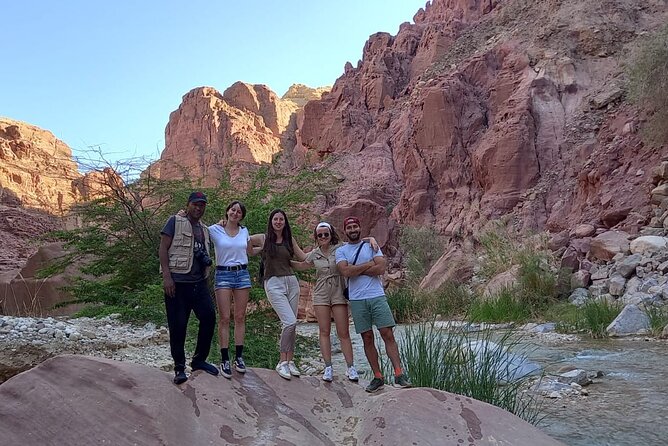
Half-Day Jeep and Hiking Bedouin Tour from Wadi Rum Village
Read our review →Browse the lists this tour appears in